Come on You Know I Come From an Educated Family
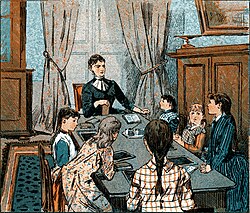
A person educating children at habitation
Homeschooling or home schooling, also known as home education or elective dwelling educational activity (EHE), is the education of school-anile children at home or a variety of places other than a school.[ane] Commonly conducted by a parent, tutor, or an online teacher, many homeschool families use less formal, more personalized and individualized methods of learning that are not ever institute in schools. The actual practice of homeschooling can look very different. The spectrum ranges from highly structured forms based on traditional school lessons to more open, free forms such equally unschooling, which is a lesson- and curriculum-complimentary implementation of homeschooling. Some families who initially attended a school go through a deschool stage to break away from school habits and prepare for homeschooling. While "homeschooling" is the term commonly used in Due north America, "home education" is primarily used in Europe and many Republic countries. Homeschooling should not be confused with distance pedagogy, which generally refers to the arrangement where the student is educated by and conforms to the requirements of an online school, rather than being educated independently and unrestrictedly by their parents or by themselves.
Earlier the introduction of compulsory school omnipresence laws, most childhood education was washed by families and local communities. By the early 19th century, attention a school became the nearly common means of education in the developed globe. In the mid to belatedly 20th century, more people began questioning the efficiency and sustainability of school learning, which again led to an increment in the number of homeschoolers, specially in the Americas and some European countries. Today, homeschooling is a relatively widespread form of education and a legal alternative to public and private schools in many countries, which many people believe is due to the rise of the Internet, which enables people to obtain data very quickly. At that place are also nations in which homeschooling is regulated or illegal, equally recorded in the article Homeschooling international status and statistics. During the COVID-nineteen pandemic, many students from all over the globe had to study from abode due to the danger posed by the virus. However, this was generally implemented in the form of altitude teaching rather than traditional homeschooling.
There are many different reasons for homeschooling, ranging from personal interests to dissatisfaction with the public school system. Some parents see better educational opportunities for their kid in homeschooling, for example considering they know their child more accurately than a teacher and can concentrate fully on educating normally 1 to a few persons and therefore can respond more than precisely to their individual strengths and weaknesses, or because they think that they can better prepare their children for the life outside of schoolhouse. Some children tin can besides learn ameliorate at home, for example, because they are non held dorsum, disturbed or distracted from school matters, practise not feel underchallenged or overwhelmed with certain topics, detect that certain temperaments are encouraged in schoolhouse, while others are inhibited, practise not cope well with the oftentimes predetermined structure in school or are bullied there. Homeschooling is also an option for families living in remote rural areas, those temporarily abroad and those who travel frequently and therefore face the physical impossibility or difficulty of getting their children into school and families who want to spend more and better fourth dimension with their children. Health reasons and special needs can also play a role in why children cannot attend a school regularly and are at least partially homeschooled.
Critics of homeschooling debate that children may lack social contact at home, possibly resulting in children having poorer social skills. Some are also concerned that some parents may not accept the skills required to guide and advise their children in life skills. Critics also say that a kid might not encounter people of other cultures, worldviews, and socioeconomic groups if they are not enrolled in a school. Therefore, these critics believe that homeschooling cannot guarantee a comprehensive and neutral pedagogy and that children can be indoctrinated if educational standards are not prescribed and if there is no regular monitoring by controlling regime.[ additional citation(s) needed ] There are many studies that show that homeschooled children score amend on standardized tests and have equal or higher developed social skills and participate more than in cultural and family activities on boilerplate than public school students.[2] [3] In add-on, studies suggest that homeschoolers are generally more likely to have higher self-esteem, deeper friendships, and better relationships with adults, and are less susceptible to peer pressure.[4] [iii]
History [edit]
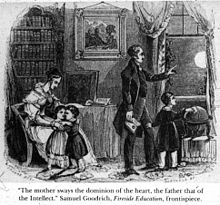
For well-nigh of history and in dissimilar cultures, homeschooling was a mutual practice by family members and local communities.[5] Enlisting professional person tutors was an option available only to the wealthy. Homeschooling declined in the 19th and 20th centuries with the enactment of compulsory schoolhouse omnipresence laws. All the same, it continued to be practised in isolated communities. Homeschooling began a resurgence in the 1960s and 1970s with educational reformists dissatisfied with industrialized education.[five]
The earliest public schools in modern Western civilisation were established during the reformation with the encouragement of Martin Luther in the German language states of Gotha and Thuringia in 1524 and 1527.[6] From the 1500s to 1800s the literacy charge per unit increased until a majority of adults were literate, only development of the literacy rate occurred before the implementation of compulsory attendance and universal education.[seven]
Home education and apprenticeship continued to remain the chief form of educational activity until the 1830s.[8] All the same, in the 18th century, the bulk of people in Europe lacked formal education.[ix] Since the early on 19th century, formal classroom schooling became the most common means of schooling throughout the developed countries.[x]
In 1647, New England provided compulsory elementary education. Regional differences in schooling existed in colonial America. In the south, farms and plantations were so widely dispersed that customs schools such as those in the more compact settlements of the n were incommunicable. In the middle colonies, the educational situation varied when comparing New York with New England.[11]
Well-nigh Native American tribal cultures traditionally used homeschooling and apprenticeship to pass knowledge to children. Parents were supported by extended relatives and tribal leaders in the education of their children. The Native Americans vigorously resisted compulsory education in the The states.[12]
In the 1960s, Rousas John Rushdoony began to advocate homeschooling, which he saw as a style to combat the secular nature of the public school system in the The states. He vigorously attacked progressive school reformers such every bit Horace Isle of man and John Dewey, and argued for the dismantling of the land's influence in education in three works: Intellectual Schizophrenia, The Messianic Graphic symbol of American Instruction, and The Philosophy of the Christian Curriculum. Rushdoony was frequently called equally an skillful witness past the Abode School Legal Defense Clan (HSLDA) in court cases. He oft advocated the employ of private schools.[xiii]
During this time, American educational professionals Raymond and Dorothy Moore began to inquiry the bookish validity of the rapidly growing Early Childhood Education movement. This research included independent studies by other researchers and a review of over 8,000 studies bearing on early babyhood education and the concrete and mental development of children.[ citation needed ]
They asserted that formal schooling earlier ages 8–12 not just lacked the anticipated effectiveness just likewise harmed children. The Moores published their view that formal schooling was damaging immature children academically, socially, mentally, and fifty-fifty physiologically. The Moores presented show that childhood problems such as juvenile malversation, nearsightedness, increased enrollment of students in special teaching classes and behavioral bug were the results of increasingly earlier enrollment of students.[14] The Moores cited studies demonstrating that orphans who were given surrogate mothers were measurably more intelligent, with superior long-term effects – even though the mothers were "mentally retarded teenagers" – and that illiterate tribal mothers in Africa produced children who were socially and emotionally more than avant-garde than typical western children, "by western standards of measurement".[14]
Their primary assertion was that the bonds and emotional development made at home with parents during these years produced disquisitional long-term results that were cut short by enrollment in schools, and could neither exist replaced nor corrected in an institutional setting subsequently.[fourteen] Recognizing a necessity for early out-of-home care for some children, particularly special needs and impoverished children and children from exceptionally inferior homes,[15] [ clarification needed ] they maintained that the vast majority of children were far better situated at home, even with mediocre parents, than with the almost gifted and motivated teachers in a school setting. They described the difference as follows: "This is like saying, if you can help a kid by taking him off the cold street and housing him in a warm tent, then warm tents should exist provided for all children – when obviously most children already accept fifty-fifty more secure housing."[14]
The Moores embraced homeschooling after the publication of their get-go work, Meliorate Tardily Than Early, in 1975, and became important homeschool advocates and consultants with the publication of books such as Domicile Grown Kids (1981), and Homeschool Exhaustion.[xvi]
Simultaneously, other authors published books questioning the premises and efficacy of compulsory schooling, including Deschooling Society by Ivan Illich in 1970 and No More Public Schoolhouse past Harold Bennet in 1972.
In 1976, educator John Holt published Instead of Education; Ways to Help People Do Things Better. In its conclusion, he chosen for a "Children'south Hush-hush Railroad" to help children escape compulsory schooling.[17] In response, Holt was contacted by families from around the U.South. to tell him that they were educating their children at home. In 1977, after corresponding with a number of these families, Holt began producing the magazine Growing Without Schooling (GSW), a newsletter dedicated to home didactics.[eighteen] Holt was nicknamed the "male parent of homeschooling."[5] Holt later wrote a book about homeschooling, Teach Your Ain, in 1981.
In 1980, Holt said,
"I want to make information technology clear that I don't see homeschooling as some kind of reply to badness of schools. I recall that the home is the proper base for the exploration of the earth which we call learning or pedagogy. The home would be the best base no matter how skilful the schools were."[nineteen]
Ane common theme in the homeschool philosophies of both Holt and that of the Moores is that home education should not endeavor to bring the school to construct into the abode, or a view of instruction as an academic preliminary to life. They viewed habitation education equally a natural, experiential aspect of life that occurs as the members of the family are involved with one another in daily living.[20] [21]
Homeschooling can be used as a course of supplemental pedagogy and as a way of helping children learn under specific circumstances. The term may besides refer to pedagogy in the home nether the supervision of correspondence schools or umbrella schools. Some jurisdictions require adherence to an approved curriculum.[22] In the 1970s, a mod homeschooling motility began when American educator and writer John Holt questioned the efficiency of schools and the sustainability of school learning, arguing that schools focus on strictly doing "skill drill" instead of other methods of learning.[23] [24] The influence of Raymond Moore is sometimes also held responsible for this motion on the religious right.[24] A curriculum-free philosophy of homeschooling chosen "unschooling" also emerged around this time, although information technology would take a few more decades for this form of education to go popular. The term was coined in 1977 past Holt's GWS. The term emphasizes the more spontaneous, less structured learning environment in which a child's interests drive his pursuit of knowledge.[25] Some parents provide a liberal arts instruction using the trivium and quadrivium every bit the main models.[26] [27]
While "homeschooling" is the term commonly used in the Usa and other nations in North America, "home education" is primarily used in the United Kingdom, elsewhere in Europe and many Commonwealth countries.[one] [28] [29] Some believe that homeschooling has get more than attractive and popular than ever before since the days of quick information retrieval on the Internet.[thirty] [31] [32] [33]
The COVID-xix pandemic led to school closures around the world,[34] [35] which is why over 300 million students had to study from home.[36] Since the material to be learned was mainly outsourced to home and specified and checked by virtual schools, information technology can be said that this was mostly implemented in the form of altitude education rather than traditional homeschooling in which parents brainwash their kid independent from school. Because the transition to homeschooling often happened overnight without any possibilities of preparation for parents, teachers and children, this caused economic,[37] [38] educational,[34] [39] [40] political[41] [42] [43] and psychological distress.[44]
Motivations [edit]

When homeschooling is a selection, families have dissimilar reasons for choosing it. This cake diagram shows the motivations regarded equally most important for homeschooling in the United States as of 2007.[45]
There are a multitude of sometimes circuitous reasons why parents and children cull to homeschool, some of which overlap with those for unschooling and may exist very different depending on the country and (current) situation of parents and children.
Parents usually cite two main motivations for homeschooling their children: dissatisfaction with the local schools and the interest in increased involvement with their children'due south learning and development. Parental dissatisfaction with available schools typically includes concerns well-nigh the schoolhouse environment, the quality of academic instruction, the curriculum, bullying, racism and lack of religion in the school's ability to cater to their children's special needs.[46] Some parents homeschool in social club to have greater command over what and how their children are taught, to cater more fairly to an individual child'southward aptitudes and abilities, to provide instruction from a specific religious or and moral position, and to have advantage of the efficiency of one-to-one instruction and thus allow the child to spend more time on childhood activities, socializing, and non-academic learning.[47]
Some African-American families choose to homeschool as a way of increasing their children's understanding of African-American history – such as the Jim Crow laws that resulted in African Americans being prevented from reading and writing – and to limit the damage acquired by the unintentional and sometimes subtle systemic racism that affects most American schools.[48]
Some parents take objections to the secular nature of public schools and homeschool in order to give their children a religious didactics. Use of a religious curriculum is common among these families.
Some parents are of the opinion that certain temperaments are promoted in schoolhouse, while others are inhibited which may besides be a reason to homeschool their children.[49]
Another argument for homeschooling children may be the protection against physical and emotional violence, bullying, exclusion, drugs, stress, sexualization, social pressures, excessive performance thoughts, socialization groups or role models with negative impact and degrading handling in school.[fifty] [51] [52] [53] [54] [55] [56]
Some children may as well adopt to or tin learn more efficiently at home, for example, because they are not distracted or slowed down by school matters and can, for example, spend several hours dealing with the same topic undisturbed. There are studies that show that homeschooled children are more probable to graduate and perform better at university.[57]
Homeschooling may also be a factor in the pick of parenting manner. Homeschooling can exist a matter of consistency for families living in isolated rural locations, for those temporarily abroad, and for those who travel frequently.[58] Many young athletes, actors, and musicians are taught at home to accommodate their training and exercise schedules more than conveniently. Homeschooling can be nearly mentorship and apprenticeship, in which a tutor or teacher is with the kid for many years and becomes more intimately acquainted with the child.[59] Many parents also homeschool their children and return their kid into the school system afterward on, for case because they think that their kid is besides young or not nonetheless ready to start schoolhouse.[47]
Some children too take health issues and therefore cannot attend a schoolhouse regularly and are at least partially homeschooled or take distance didactics instead.[56] [60]
Another commonly cited reason for choosing homeschooling is the flexibility and freedom which parents and children have.[55]
COVID-nineteen has reinforced some parent's minds about homeschooling. The fact that parents realized remote learning was possible thank you to new technologies means that they have additional options to consider should their child face problems of any kind at school. [61]
Teaching methods, forms and philosophies [edit]
Homeschooling is ordinarily conducted by a parent, tutor, or an online teacher,[62] but the concrete practice tin be very unlike. The spectrum ranges from highly structured forms based on traditional school lessons to more open, complimentary forms like unschooling.[63] This is a curriculum-free implementation of homeschooling that involves teaching children based on their interests.[64] [65] [66]
Many homeschool families use a wide multifariousness of methods and materials and less formal educational methods, which represent a diverseness of educational philosophies and paradigms.[67] Some of the methods or learning environments used include classical pedagogy (including Trivium, Quadrivium), Charlotte Bricklayer pedagogy, Montessori method, theory of multiple intelligences, unschooling, Waldorf education, school-at-home (curriculum choices from both secular and religious publishers), A Thomas Jefferson Education, unit studies, curriculum made upward from private or pocket-size publishers, apprenticeship, hands-on-learning, distance learning (both online and correspondence), dual enrollment in local schools or colleges, and curriculum provided by local schools and many others. Some of these approaches are used in individual and public schools.[ citation needed ] Educational research and studies support the employ of some of these methods. Unschooling, natural learning, Charlotte Mason Teaching, Montessori, Waldorf, apprenticeship, hands-on-learning, unit studies are supported to varying degrees by research by constructivist learning theories and situated cognition theories.[ description needed ] Elements of these theories may be found in the other methods as well.
A pupil's education may be customized to support his or her learning level, mode, and interests.[68] Information technology is not uncommon for a educatee to experience more than one arroyo as the family discovers what works all-time for their student. Many families utilize an eclectic approach, picking and choosing from various suppliers. For sources of curricula and books, a study plant that 78 percent utilized "a public library"; 77 percentage used "a homeschooling catalogue, publisher, or individual specialist"; 68 percentage used "retail bookstore or another store"; 60 percent used "an pedagogy publisher that was non affiliated with homeschooling." "Approximately half" used curriculum from "a homeschooling organization", 37 percent from a "church building, synagogue or other religious institution" and 23 percent from "their local public schoolhouse or district." In 2003, 41 per centum utilized some sort of distance learning, approximately 20 percent by "telly, video or radio"; 19 percentage via "The Net, email, or the World wide web"; and fifteen percentage taking a "correspondence course by postal service designed specifically for homeschoolers."[69] [ clarification needed ]
Individual governmental units, e.g. states and local districts, vary in official curriculum and attendance requirements.[seventy]
Informal learning [edit]
Equally a subset of homeschooling, breezy learning happens outside of the classroom simply has no traditional boundaries of pedagogy. Informal learning is an everyday form of learning through participation and cosmos, in contrast with the traditional view of instructor-centered learning. The term is often combined with non-formal learning and self-directed learning. Breezy learning differs from traditional learning since there are no expected objectives or outcomes. From the learner'southward standpoint, the knowledge that they receive is not intentional. Anything from planting a garden to baking a cake or even talking to a technician at piece of work virtually the installation of new software can be considered informal learning. The individual is completing a job with unlike intentions but ends upward learning skills in the process.[71] Children watching their tomato plants abound will non generate questions most photosynthesis just they volition larn that their plants are growing with water and sunlight. This leads them to accept a base agreement of complex scientific concepts without any background studying.[72] The contempo trend of homeschooling becoming less stigmatized has been in connection with the traditional waning of the thought that the land needs to exist in master and ultimate control over the pedagogy and upbringing of all children to create future adult citizens. This breeds an always-growing importance on the ideas and concepts that children larn outside of the traditional classroom setting, including Breezy learning.
Depending on the office of the globe, breezy learning tin take on many different identities and has differing cultural importances. Many ways of organizing homeschooling draw on apprenticeship qualities and on not-western cultures. In some Due south American indigenous cultures, such as the Chillihuani community in Peru, children learn irrigation and farming technique through play, advancing them not only in their own village and social club merely also in their noesis of realistic techniques that they will need to survive.[73] In Western civilization, children use informal learning in two main ways. The get-go as talked nigh is through hands-on experience with new material. The second is request questions to someone who has more feel than they accept (i.e. parents, elders). Children'due south inquisitive nature is their mode of cementing the ideas they have learned through exposure to informal learning. It is a more than coincidental way of learning than traditional learning and serves the purpose of taking in information whatever which way they can.[74]
Structured versus unstructured [edit]
All other approaches to homeschooling are subsumed nether two basic categories: structured and unstructured homeschooling. Structured homeschooling includes whatever method or style of abode teaching that follows a basic curriculum with articulated goals and outcomes. This style attempts to imitate the construction of the traditional school setting while personalizing the curriculum. Unstructured homeschooling is any grade of habitation education where parents do not construct a curriculum at all. Unschooling, as it is known, attempts to teach through the kid's daily experiences and focuses more on self-directed learning by the kid, free of textbooks, teachers, and whatsoever formal assessment of success or failure.[75]
Unit studies [edit]
In a unit study approach, multiple subjects such as math, science, history, fine art, and geography, are studied in relation to a single topic. Unit studies are useful for didactics multiple grades simultaneously equally the difficulty level can be adjusted for each student. An extended form of unit studies, Integrated Thematic Didactics utilizes one central theme integrated throughout the curriculum so that students end a school year with a deep understanding of a certain broad subject or idea.[76]
All-in-one curricula [edit]
All-in-one homeschooling curricula (variously known every bit school-at-habitation, the traditional approach, or school-in-a-box) are instructional methods of teaching in which the curriculum and homework of the pupil are like or identical to those used in a public or private school. Purchased as a grade-level package or separately past subject field, the package may contain all of the needed books, materials, tests, respond keys, and extensive teacher guides.[77] These materials cover the same subject areas every bit public schools, allowing for an piece of cake transition into the school system. These are among the most expensive options for homeschooling, just they require minimal preparation and are easy to utilise. Some localities provide the same materials used at local schools to homeschoolers. The purchase of a complete curriculum and their teaching/grading service from an accredited distance learning curriculum provider may permit students to obtain an accredited loftier schoolhouse diploma.[ commendation needed ]
Unschooling and natural learning [edit]
Natural learning refers to a type of learning-on-demand where children pursue knowledge based on their interests and parents accept an active part in facilitating activities and experiences conducive to learning only do not rely heavily on textbooks or spend much fourth dimension "educational activity", looking instead for "learning moments" throughout their daily activities. Parents see their office as that of affirming through positive feedback and modeling the necessary skills, and the child's role every bit being responsible for request and learning.[78]
The term unschooling as coined by John Holt describes an approach in which parents do non authoritatively direct the child's education, but interact with the child following the child's own interests, leaving them free to explore and learn equally their interests lead.[nineteen] [69] "Unschooling" does non bespeak that the child is not being educated, simply that the child is not beingness "schooled", or educated in a rigid schoolhouse-blazon way. Holt asserted that children learn through the experiences of life, and he encouraged parents to alive their lives with their kid. Too known as interest-led or child-led learning, unschooling attempts to follow opportunities equally they arise in real life, through which a child will acquire without coercion. Children at schoolhouse larn from 1 teacher and two auxiliary teachers in a classroom of approximately 30. Kids take the opportunity of dedicated teaching at home with a ratio of 1 to one. An unschooled child may utilise texts or classroom instruction, only these are not considered central to pedagogy. Holt asserted that there is no specific trunk of knowledge that is, or should be, required of a child.[79]
Both unschooling and natural learning advocates believe that children learn best by doing; a kid may larn reading to further an interest about history or other cultures, or math skills by operating a small business or sharing in family finances. They may learn beast husbandry keeping dairy goats or meat rabbits, botany tending a kitchen garden, chemical science to understand the operation of firearms or the internal combustion engine, or politics and local history past following a zoning or historical-status dispute. While any type of homeschoolers may besides apply these methods, the unschooled child initiates these learning activities. The natural learner participates with parents and others in learning together.[66]
Another prominent proponent of unschooling is John Taylor Gatto, author of Dumbing Us Down, The Exhausted School, A Different Kind of Instructor, and Weapons of Mass Instruction. Gatto argues that public education is the primary tool of "state-controlled consciousness" and serves equally a prime illustration of the total institution — a social arrangement which impels obedience to the country and quells gratis-thinking or dissent.[80]
Democratic learning [edit]
Autonomous learning is a school of education which sees learners every bit individuals who tin can and should be autonomous i.east. be responsible for their own learning climate.
Autonomous education helps students develop their self-consciousness, vision, practicality, and freedom of discussion. These attributes serve to assist the student in his/her contained learning. Withal, a student must non start their autonomous learning completely on their own. It is said, that past beginning having interaction with someone who has more knowledge in a subject, will speed up the student's learning, and hence allow them to learn more than independently.[81]
Some degree of autonomous learning is popular with those who dwelling house educate their children. In true autonomous learning, the child usually gets to decide what projects they wish to tackle or what interests to pursue. In-home teaching, this can be instead of or in addition to regular subjects similar doing math or English.
According to Home Education UK, the autonomous didactics philosophy emerged from the epistemology of Karl Popper in The Myth of the Framework: In Defence force of Science and Rationality, which is developed in the debates, which seek to rebut the neo-Marxist social philosophy of convergence proposed by the Frankfurt School (e.g. Theodor Westward. Adorno, Jürgen Habermas, Max Horkheimer).[ commendation needed ]
Hybrid homeschooling [edit]
Hybrid homeschooling or flex-schoolhouse [47] is a class of homeschooling in which children split their time between homeschool and a more traditional schooling environs like a schoolhouse.[82] It is a comparatively unpopular pedagogy model that can mainly be found in the Usa.[83] [84] During the COVID-nineteen pandemic, this was sometimes enforced by schools.[85]
A commonly cited reason for choosing this model is that parents are not sure whether they can provide their children a comprehensive and neutral education at home or cannot devote themselves to homeschooling full-time due to time constraints or excessive stress.[82] [86] Some families also desire their children to socialize with other children and find that schools are better suited for this purpose because social exchange does not only take place occasionally, merely is an everyday feel there.[82] [86]
Homeschool cooperatives [edit]
A homeschool cooperative is a cooperative of families who homeschool their children. Information technology provides an opportunity for children to learn from other parents who are more specialized in certain areas or subjects. Co-ops also provide social interaction. They may take lessons together or become on field trips. Some co-ops likewise offer events such every bit prom and graduation for homeschoolers.[87]
Homeschoolers are beginning to utilize Web 2.0 as a way to simulate homeschool cooperatives online. With social networks, homeschoolers tin can chat, discuss threads in forums, share information and tips, and even participate in online classes via blackboard systems similar to those used by colleges.[88]
Inquiry [edit]
Exam results [edit]
According to the Dwelling Schoolhouse Legal Defense Association (HSLDA) in 2004, "Many studies over the last few years have established the bookish excellence of homeschooled children."[89] Home Schooling Achievement, a compilation of studies published past the HSLDA, supported the bookish integrity of homeschooling. This booklet summarized a 1997 study by Ray and the 1999 Rudner study.[90] The Rudner study noted two limitations of its own research: it is non necessarily representative of all homeschoolers and it is not a comparison with other schooling methods.[91] Amidst the homeschooled students who took the tests, the average homeschooled educatee outperformed his public school peers by thirty to 37 percentile points across all subjects. The study also indicates that public school functioning gaps betwixt minorities and genders were virtually not-existent amidst the homeschooled students who took the tests.[92]
A survey of xi,739 homeschooled students conducted in 2008 establish that, on average, the homeschooled students scored 37 percentile points above public school students on standardized accomplishment tests.[93] This is consistent with the 1999 Rudner study. Withal, Rudner said that these aforementioned students in public schoolhouse may take scored just also because of the dedicated parents they had.[94] The Ray report besides establish that homeschooled students who had a certified instructor equally a parent scored one percentile lower than homeschooled students who did non accept a certified teacher as a parent.[93] Studies accept shown homeschooled students score college on standardized tests than traditionally schooled youth[89] [93] [95] Some other nationwide descriptive study conducted by Ray contained students ranging from ages 5–18 and he found that homeschoolers scored in at to the lowest degree the 80th percentile on their tests.[96]
In 2011, a quasi-experimental report was conducted that included homeschooled and traditional public students betwixt the ages of five and ten. It was discovered that the majority of the homeschooled children achieved higher standardized scores compared to their counterparts.[97] Even so, Martin-Chang also found that unschooling children ages five–x scored significantly beneath traditionally educated children, while academically-oriented homeschooled children scored from one one-half course level above to iv.5 grade levels above traditionally schooled children on standardized tests (n=37 homeschooled children matched with children from the same socioeconomic and educational groundwork).[98]
Studies take as well examined the impact of homeschooling on students' GPAs. Cogan (2010) found that homeschooled students had higher high school GPAs (3.74) and transfer GPAs (iii.65) than conventional students.[99] Snyder (2013) provided corroborating evidence that homeschoolers were outperforming their peers in the areas of standardized tests and overall GPAs.[100] Looking across high school, a report by the 1990 National Home Education Research Institute (equally cited by Wichers, 2001) found that at to the lowest degree 33% of homeschooled students attended a four-twelvemonth higher, and 17% attended a two-year college. This same study examined the students subsequently 1 twelvemonth, finding that 17% pursued higher education.[101]
On average, studies suggest homeschoolers score at or above the national boilerplate on standardized tests. Homeschool students accept been accepted into many Ivy League universities.[5] Withal, The Coalition for Responsible Homeschooling notes that "Our knowledge of homeschooling's effect on academic achievement is limited by the fact that many of the studies that take been conducted on homeschoolers suffer from methodological problems which make their findings inconclusive."[102]
Outcomes [edit]
Homeschooled children may receive more individualized attention than students enrolled in traditional public schools. A 2011 study suggests that a structured environment could play a primal function in homeschooler academic accomplishment.[103] This ways that parents were highly involved in their kid'due south instruction and they were creating clear educational goals. In addition, these students were existence offered organized lesson plans which are either self-made or purchased.[103]
Homeschooled youth are less probable to use and abuse illicit substances and are more likely to disapprove of using alcohol and marijuana.[104] In that location are too studies according to which homeschooled children are less likely to exist sexually abused than children in public schools.[105]
In the 1970s, Raymond and Dorothy Moore conducted four federally funded analyses of more than eight,000 early on childhood studies, from which they published their original findings in Better Late Than Early, 1975. This was followed by Schoolhouse Can Look, a repackaging of these aforementioned findings designed specifically for educational professionals.[106] They concluded that "where possible, children should be withheld from formal schooling until at to the lowest degree ages eight to ten." Their reason was that children "are non mature plenty for formal school programs until their senses, coordination, neurological development and cognition are ready". They concluded that the upshot of forcing children into formal schooling is a sequence of "1) dubiousness equally the child leaves the family nest early for a less secure environment, 2) puzzlement at the new pressures and restrictions of the classroom, 3) frustration because unready learning tools – senses, cognition, encephalon hemispheres, coordination – cannot handle the regimentation of formal lessons and the pressures they bring, 4) hyperactivity growing out of nerves and jitter, from frustration, 5) failure which quite naturally flows from the four experiences above, and 6) delinquency which is failure's twin and apparently for the same reason."[107] According to the Moores, "early formal schooling is burning out our children. Teachers who attempt to cope with these youngsters too are burning out." Aside from academic performance, they retrieve early formal schooling also destroys "positive sociability", encourages peer dependence, and discourages self-worth, optimism, respect for parents, and trust in peers. They believe this situation is particularly acute for boys considering of their filibuster in maturity. The Moores cited a Smithsonian Report on the development of genius, indicating a requirement for "ane) much time spent with warm, responsive parents and other adults, 2) very fiddling time spent with peers, and 3) a nifty bargain of free exploration under parental guidance." Their analysis suggested that children demand "more of dwelling and less of formal schoolhouse", "more free exploration with... parents, and fewer limits of classroom and books", and "more old fashioned chores – children working with parents – and less attention to rivalry sports and amusements."[107] A written report conducted past Ray in 2010, indicates that the higher the level of parents' income, the more likely the homeschooled child is able to achieve bookish success.[108]
College teaching admittance procedures were altered due to Covid-nineteen for the traditionally schooled pupil.[109]
The ACT and SAT became exam optional, nevertheless the homeschooled applicant is required to submit college archway exams.[110]
A Some homeschoolers averaged higher scores on these higher entrance tests in South Carolina.[111] Other scores (1999 information) showed mixed results, for example showing higher levels for homeschoolers in English (homeschooled 23.iv vs national average xx.5) and reading (homeschooled 24.4 vs national average 21.4) on the Human action, but mixed scores in math (homeschooled 20.4 vs national boilerplate 20.7 on the Human activity every bit opposed homeschooled 535 vs national boilerplate 511 on the 1999 Sat math).[112]
Some advocates of homeschooling and educational option counter with an input-output theory, pointing out that home educators expend but an average of $500–$600 a year on each student (not counting the cost of the parents' fourth dimension), in comparison to $nine,000–$ten,000 (including the toll of staff time) for each public schoolhouse student in the United States, which suggests home-educated students would exist especially dominant on tests if afforded admission to an equal delivery of revenue enhancement-funded educational resources.[113]
Many teachers and schoolhouse districts oppose the idea of homeschooling. However, research has shown that homeschooled children often excel in many areas of academic endeavour. According to a study done on the homeschool motility,[114] homeschoolers often accomplish academic success and admission into elite universities. Co-ordinate to the National Habitation Education Enquiry Institute president, Brian Ray, socialization is not a problem for homeschooling children, many of whom are involved in community sports, volunteer activities, book groups, or homeschool co-ops.[115]
[edit]
Using the Piers-Harris Children's Self-Concept Scale, John Taylor later constitute that, "while one-half of the conventionally schooled children scored at or below the 50th percentile (in cocky-concept), only 10.3% of the home-schooling children did so."[116] He farther stated that "the self-concept of home-schooling children is significantly higher statistically than that of children attention conventional school. This has implications in the areas of bookish achievement and socialization which have been constitute to parallel self-concept. Regarding socialization, Taylor's results would mean that very few abode-schooling children are socially deprived. He states that critics who speak out against homeschooling on the basis of social deprivation are really addressing an area which favours homeschoolers.[116]
In 2003, the National Abode Instruction Research Institute conducted a survey of vii,300 U.S. adults who had been homeschooled (5,000 for more seven years). Their findings included:
-
- Homeschool graduates are active and involved in their communities. 71% participate in an ongoing community service activity, similar coaching a sports squad, volunteering at a schoolhouse, or working with a church building or neighborhood clan, compared with 37% of U.Due south. adults of like ages from a traditional education background.
- Homeschool graduates are more involved in civic affairs and vote in much higher percentages than their peers. 76% of those surveyed betwixt the ages of 18 and 24 voted within the last five years, compared with simply 29% of the corresponding U.South. populace. The numbers are even greater in older age groups, with voting levels not falling beneath 95%, compared with a high of 53% for the respective U.S. populace.
- 58.9% report that they are "very happy" with life, compared with 27.6% for the general U.Due south. population. 73.2% find life "heady", compared with 47.3%[117]
Some advocates of homeschooling and educational option counter with an input-output theory, pointing out that home educators expend merely an average of $500–$600 a year on each educatee (not counting the cost of the parents' fourth dimension), in comparison to $9,000–$x,000 (including the cost of staff fourth dimension) for each public school student in the United States, which suggests home-educated students would be especially dominant on tests if afforded access to an equal commitment of taxation-funded educational resource.[113]
Many teachers and school districts oppose the idea of homeschooling. Notwithstanding, inquiry has shown that homeschooled children frequently excel in many areas of bookish endeavour. According to a written report done on the homeschool move,[118] homeschoolers ofttimes achieve academic success and admission into elite universities. According to the National Home Education Inquiry Found president, Brian Ray, socialization is non a problem for homeschooling children, many of whom are involved in customs sports, volunteer activities, volume groups, or homeschool co-ops.[119]
Richard G. Medlin, Ph.D.'due south enquiry found that homeschooled children take ameliorate social skills than children attending traditional schools.[120]
Legality and prevalence [edit]
General criticism [edit]
Resistance to homeschooling comes from some organizations of teachers and schoolhouse districts. The National Instruction Association, a United States teachers' union and professional association, has asserted that teachers should be licensed and that state-approved curricula should exist used.[121] [122]
Critics debate that homeschooled children tin can be indoctrinated if educational standards are not prescribed and if there is no regular monitoring by controlling authorities.[123]
Elizabeth Bartholet, a Harvard professor of police force and faculty director of the Law Schoolhouse'south Kid Advocacy Program, recommended a ban on home education in 2019, calling it a risky do.[124]
Political scientist Rob Reich (not to exist confused with the old Labor Secretary Robert Reich)[125] speculated in The Civic Perils of Homeschooling (2002) that homeschooling could threaten to "insulate students from exposure to diverse ideas and people."[126] [127]
Gallup polls of American voters accept shown a significant change in attitude in the last 20 years, from 73% opposed to homeschooling in 1985 to 54% opposed in 2001.[128] [129] In 1988, when asked whether parents should accept a right to choose homeschooling, 53 percent idea that they should, as revealed by another poll.[130]
Meet also [edit]
- Alternative pedagogy
- History of education
- Homeschooling during the COVID-19 pandemic
- Homeschooling and alternative education in India
- Homeschooling and distance didactics in Australia
- Homeschooling in Canada
- Homeschooling in the United states
- Dwelling education in the Great britain
- Homeschooling in New Zealand
- Homeschooling in Southward Africa
- Domicile School Legal Defense force Association
- Informal learning
- List of homeschooling programmes
References [edit]
- ^ a b "Constituent dwelling house teaching—Guidelines for local authorities" (PDF). gov.united kingdom of great britain and northern ireland. Section 1.2. p. 3. Archived from the original (PDF) on 2018-05-22. Retrieved 2018-10-xi .
{{cite web}}: CS1 maint: location (link) - ^ Wise, Rachel (2020-x-15). "What Does the Inquiry Say About the Bear upon of Homeschooling on Academics and Social Skills?". Education and Beliefs . Retrieved 2020-12-26 .
- ^ a b Slater, Dr Eileen; Burton, Kate. "Homeschooled children are far more socially engaged than you might call back". The Conversation . Retrieved 2020-12-26 .
- ^ Potter, Haley. "Do domicile-schoolers practice improve in college than traditional students?". USA TODAY . Retrieved 2020-12-26 .
- ^ a b c d A. Distefano, K. E. Rudestam, R. J. Silverman (2005) Encyclopedia of Distributed Learning Archived 2016-01-01 at the Wayback Auto (p221) ISBN 0-7619-2451-v
- ^ "Educational activity: Gratuitous and Compulsory". Mises Institute. 2014-08-18. Archived from the original on 7 November 2014. Retrieved 19 Apr 2016.
- ^ Houston, Robert (2011-11-28). "Literacy". Archived from the original on 2017-09-14. Retrieved 2017-09-thirteen .
- ^ "History of Culling Education in the United States". Archived from the original on four March 2016. Retrieved 19 Apr 2016.
- ^ Welton, James (1911). . In Chisholm, Hugh (ed.). Encyclopædia Britannica. Vol. eight (11th ed.). Cambridge University Press. pp. 951–989, see page 959, fourth para, concluding line.
But the total results were not keen; the mass of the people in every European state remained without schooling throughout the 18th century.
- ^ Cvrcek, Tomas; Zajicek, Miroslav (2019-09-01). "The ascension of public schooling in nineteenth-century Royal Austria: Who gained and who paid?". Cliometrica. 13 (3): 367–403. doi:10.1007/s11698-018-0180-6. ISSN 1863-2513.
- ^ "How they were schooled". Archived from the original on 29 April 2016. Retrieved 19 Apr 2016.
- ^ "Removing Classrooms from the Battle | SUTHERLAND INSTITUTE" (PDF). SUTHERLAND Institute. 2008-07-29. p. 377,386 Notation 30. Archived from the original (PDF) on 2017-08-08. Retrieved 2017-08-23 .
- ^ Edgar, William (January 2007). "The Passing of R. J. Rushdoony". First Things. Archived from the original on Apr 4, 2014. Retrieved 2014-04-23 .
- ^ a b c d Improve Belatedly Than Early on, Raymond S. Moore, Dorothy North. Moore, 1975
- ^ Amall, Judy (2018). Unschooling To University: Relationships Matter Most in a World Crammed With Content (1 ed.). Professional person Parenting, Calgary, Alberta, Canada. p. 24. ISBN9780978050993 . Retrieved 12 February 2020.
- ^ "Raymond & Dorothy Moore: Homeschool Pioneers". CCHE. 2018-09-18. Archived from the original on 2019-12-29. Retrieved 2019-04-10 .
- ^ Christine Field. The Former Schoolhouse Meets Up with Patrick Farenga About the Legacy of John Holt Archived August 16, 2011, at the Wayback Motorcar
- ^ "HSC - A Brief History of Homeschooling". 2007-12-15. Archived from the original on 2007-12-15. Retrieved 2017-08-23 .
- ^ a b "A Conversation with John Holt - The Natural Child Project". Archived from the original on twenty September 2017. Retrieved nineteen Apr 2016.
- ^ "A Chat with John Holt - The Natural Child Projection". www.naturalchild.org. Archived from the original on 2017-09-20. Retrieved 2017-04-04 .
- ^ "Moore Habitation Schooling : Moore Formula". www.moorefoundation.com. Archived from the original on 2016-03-05. Retrieved 2017-04-04 .
- ^ HSLDA. "Homeschooling in New York: A legal analysis" (PDF). Archived from the original (PDF) on thirty April 2006. Retrieved 13 September 2013.
- ^ "A Brief History of Homeschooling". Coalition for Responsible Abode Education. 2014-03-08. Retrieved 2020-xi-01 .
- ^ a b Carter, Joe. "9 Things You Should Know About the History of the Homeschooling Movement". The Gospel Coalition . Retrieved 2020-eleven-01 .
- ^ "Unschooling and Homeschooling FAQ | Alternative Schooling | Self Directed Learning". John Holt GWS. Archived from the original on 2015-07-07. Retrieved 2015-07-16 .
- ^ "Build a Well-Rounded Liberal Arts Home School Curriculum". www.brighthubeducation.com. 2011-01-29. Retrieved 2020-10-10 .
- ^ chscurriculum (2019-04-26). "What Exercise Nosotros mean By Liberal Arts?". Classical Homeschool Curriculum . Retrieved 2020-10-10 .
- ^ Rothermel, Paula (20 March 2015). International perspectives on domicile education : do we however need schools?. ISBN978-1137446848.
- ^ Bhopal & Myers, Kalwant, Martin (2018-05-02). Home schooling and home instruction : race, class and inequality. ISBN978-1138651340.
- ^ "Here's Why Homeschooling Actually Makes More Sense in the Digital Age". Red Tricycle. 2019-02-25. Retrieved 2020-xi-01 .
- ^ Team, Editorial (2020-09-20). "How Has Homeschooling Changed in the Digital Historic period?". Learning Links Academy . Retrieved 2020-11-01 .
- ^ "How the Internet Changed Homeschooling". Acellus University. 2019-xi-13. Retrieved 2020-eleven-01 .
- ^ "The Role of Homeschooling in the Modern Era". ResearchGate . Retrieved 2020-xi-01 .
- ^ a b "Parents Are Sharing Their Homeschool Fails And We Tin't Stop Laughing". IFLScience . Retrieved 2020-11-27 .
- ^ "What Past Instruction Emergencies Tell Us Almost Our Hereafter". Edutopia . Retrieved 2020-11-27 .
- ^ "50+ Homeschooling Statistics 2021 - US Data and Trends". 2021-03-05. Retrieved 2021-10-12 .
- ^ Psacharopoulos, George; Patrinos, Harry; Collis, Victoria; Vegas, Emiliana (2020-04-29). "The COVID-nineteen cost of school closures". Brookings . Retrieved 2020-08-03 .
- ^ Lindzon, Jared (2020-03-xx). "Schoolhouse closures are starting, and they'll accept far-reaching economic impacts". Fast Visitor . Retrieved 2020-08-03 .
- ^ Goldstein, Dana (2020-06-05). "Enquiry Shows Students Falling Months Behind During Virus Disruptions". The New York Times . Retrieved 2020-08-03 .
- ^ "Parents are sharing homeschooling fails every bit they attempt to teach children". The Independent. 2020-03-25. Retrieved 2020-11-27 .
- ^ Peek, Liz (2020-07-17). "Dems, Instructor Unions Playing Politics With Schoolhouse Closures". Real Articulate Politics . Retrieved 2020-08-03 .
- ^ Perper, Rosie (2020-07-07). "Trump is pushing to reopen schools, which he claims are closed for political reasons and not to adjourn the coronavirus' spread". Business Insider . Retrieved 2020-08-03 .
- ^ "Growing number of districts decide to first the school year online". EdSource. 2020-07-14. Retrieved 2020-08-03 .
- ^ "Mental wellness effects of school closures during COVID-19". The Lancet. 2020-04-14. Retrieved 2020-08-03 .
- ^ 1.v Meg Dwelling house-schooled Students in the Usa in 2007 Upshot Brief from Institute of Didactics Sciences, U.S. Section of Education. Dec 2008. NCES 2009–030
- ^ "Record numbers of children are now homeschooled, but who's keeping an eye on the parents?". Archived from the original on 2018-10-16. Retrieved 2018-09-28 .
- ^ a b c "10 expert reasons to dwelling house schoolhouse your child". the Guardian. 2016-09-10. Retrieved 2020-12-15 .
- ^ Anderson, Melinda D. (2018-05-17). "The Radical Self-Reliance of Black Homeschooling". The Atlantic. Archived from the original on 2018-07-02. Retrieved 2018-07-02 .
- ^ "Where Did This Child Come From? Homeschooling by the Temperaments - Seton Magazine". 2020-02-11. Retrieved 2020-09-05 .
- ^ "Homeschooling & Co. als Alternative?". world wide web.trendyone.de (in German language). Retrieved 2020-08-07 .
- ^ Krummenacher, Jörg (2019-09-sixteen). "Aus Misstrauen gegenüber dem Staat: Immer mehr Eltern unterrichten ihre Kinder privat". world wide web.nzz.ch (in German).
- ^ WELT (2016-11-13). "Unschooling: Lernen ohne Schule, ohne Noten, ohne Lehrer". DIE WELT (in German). Retrieved 2020-08-07 .
- ^ Weller, Chris (2018-01-21). "Homeschooling could be the smartest style to teach kids in the 21st century — hither are 5 reasons why". Business Insider . Retrieved 2020-09-05 .
- ^ "Top 5 Reasons Why Parents Homeschool Their Kids". Calvert Education. 2016-08-09. Retrieved 2020-09-05 .
- ^ a b America, High School Of (2019-eleven-26). "Does Homeschooling Benefit Mental Wellness?". Medium . Retrieved 2020-12-fifteen .
- ^ a b "Reasons Parents Homeschool". Coalition for Responsible Home Didactics. 2013-09-11. Archived from the original on 2016-05-04. Retrieved 2016-05-15 .
- ^ News, U. Southward.; Written report, World (2012-06-01). "Why Homeschooled Teens Are Ahead Of The Game For Higher". HuffPost . Retrieved 2020-12-15 .
- ^ "Why The Homeschool Movement Is Growing". Modern Homeschool Family. 2016-05-31. Retrieved 2020-11-01 .
- ^ Pickert, Lori (2012). Projection-Based Homeschooling: Mentoring Self-Directed Learners. ebook. Retrieved 12 February 2020. [ permanent dead link ]
- ^ "No Regrets: Homeschooling for Medical Reasons". Retrieved 2020-12-xv .
- ^ "Covid-nineteen has persuaded some parents that home-schooling is better". the Economist. 27 February 2021. Retrieved 2021-08-20 .
- ^ "Homeschool." Dictionary.com. Dictionary.com, 2015. Web. 3 June 2015. Dictionary.reference.com Archived 2016-03-02 at the Wayback Auto
- ^ Miller, Tyler (2014-x-fifteen). "How Is Unschooling Dissimilar From Homeschooling?". www.noodle.com . Retrieved 2020-x-ten .
- ^ "What Is Unschooling? A Parents Guide to Child-Led Home Education". Parents . Retrieved 2020-12-xv .
- ^ "Unschooling - letting children grow up without school or teachers". dpa International . Retrieved 2020-12-15 .
- ^ a b "What is Unschooling?". www.educationcorner.com. Archived from the original on 2019-12-24. Retrieved 2019-03-18 .
- ^ "Informal learning, home teaching and homeschooling (home schooling)". YMCA George Williams Higher. 2013-05-08. Retrieved 2020-12-21 .
- ^ "12 Most Compelling Reasons to Homeschool Your Children". 12most.com. 2012-02-07. Archived from the original on 2012-02-09. Retrieved 2014-01-sixteen .
- ^ a b "Homeschooling in the United States: 2003 - Executive Summary". Archived from the original on three March 2016. Retrieved 19 April 2016.
- ^ "HSLDA - Home Schooling-State". Archived from the original on 22 April 2016. Retrieved xix Apr 2016.
- ^ Livingstone, D. West. (2006). "Informal Learning: Conceptual Distinctions and Preliminary Findings". Counterpoints. 249: 203–227. JSTOR 42979596.
- ^ Crawford, Elizabeth Outlaw; Heaton, Emily T.; Heslop, Karen; Kixmiller, Kassandra (2009). "Science Learning at Dwelling Involving Families". Yc Immature Children. 64 (6): 39–41. JSTOR 42731048.
- ^ Bolin, Inge (November 2006). "Growing up in a Culture of Respect: Child Rearing in Highland Peru". Journal of Latin American Anthropology. 11 (ii): 430–432. doi:10.1525/jlca.2006.eleven.two.430. ISSN 1085-7052.
- ^ Legare, Cristine H.; Sobel, David Chiliad.; Callanan, Maureen (October 2017). "Causal learning is collaborative: Examining explanation and exploration in social contexts". Psychonomic Bulletin & Review. 24 (5): 1548–1554. doi:10.3758/s13423-017-1351-3. ISSN 1531-5320. PMID 28744768.
- ^ Martin-Chang, S.; Gould, O. Due north.; & Meuse, R. Eastward. (2011). "The touch of schooling on academic achievement: Evidence from homeschooled and traditionally schooled students". Canadian Journal of Behavioural Science. 43 (three): 195–202. doi:10.1037/a0022697. ProQuest 878227015.
- ^ Randle, Inga (1997). "The measure of success: Integrated Thematic Instruction". The Clearing Business firm. 71 (two): 85. doi:ten.1080/00098659709599331.
- ^ "Homeschooling Approaches - School-at-Habitation". www.homeschool.com. Archived from the original on 2017-07-07. Retrieved 2017-ten-24 .
- ^ Gray, Peter (April 15, 2017). "Self-Directed Education—Unschooling and Autonomous Schooling". Archived copy. Oxford Inquiry Encyclopedia of Didactics. Oxford University Press. doi:10.1093/acrefore/9780190264093.013.80. ISBN9780190264093. Archived from the original on September 19, 2018. Retrieved September xviii, 2018.
{{cite book}}: CS1 maint: archived copy as championship (link) - ^ "Why is education of import, homeschooling and the Montessori method". Archived from the original on 5 Feb 2016. Retrieved 19 April 2016.
- ^ John Taylor Gatto, Weapons of Mass Instruction (Odysseus Grouping, 2008).
- ^ L. W. Chiu, Hazel (2012). "Supporting the development of autonomous learning skills in reading and writing in an independent linguistic communication learning centre". Studies in Cocky-Admission Learning Journal. iii: 271–272. Archived from the original on 2016-11-29. Retrieved 2016-11-28 .
- ^ a b c McShane, Mike. "Is Hybrid Homeschooling The Wave Of The Hereafter?". Forbes . Retrieved 2020-12-14 .
- ^ "Tin Hybrid Home Schooling "Cross the Chasm?"". EdChoice. 2019-12-10. Retrieved 2020-12-fifteen .
- ^ "Homeschooling – the Future of Schools or a Dying Breed?". YouTube. Archived from the original on 2021-12-xi.
- ^ McShane, Mike. "How To Hybrid Homeschool This Fall". Forbes . Retrieved 2020-12-15 .
- ^ a b Lenz, Lyz (2020-08-xviii). "A Family Looks Back on Their Hybrid Home-Schoolhouse Experience". The New York Times. ISSN 0362-4331. Retrieved 2020-12-xv .
- ^ "CHN - Homeschool FAQ". californiahomeschool.net. Archived from the original on 2016-ten-01. Retrieved 2016-10-05 .
- ^ "Homeschool Technology and Online Advice - National Domicile Education Research Found". National Dwelling Education Enquiry Institute . Retrieved 2018-02-02 . [ permanent dead link ]
- ^ a b "HSLDA - Academic Statistics on Homeschooling". Archived from the original on 21 April 2016. Retrieved xix April 2016.
- ^ "Academic Achievement". HSLDA. Archived from the original on 31 Oct 2012. Retrieved 12 Oct 2012.
- ^ Rudner, Lawrence M. (1999-03-23). "Achievement and Demographics of Home Schoolhouse Students". Pedagogy Policy Analysis Athenaeum. 7: 8. doi:10.14507/epaa.v7n8.1999.
- ^ "HSLDA - Home Schooling Accomplishment". Archived from the original on 12 Apr 2016. Retrieved 19 April 2016.
- ^ a b c Ray, Brian. "Progress Report 2009: Homeschool Bookish Accomplishment and Demographics". Survey. National Home Educational activity Enquiry Institute. Archived from the original on 2013-01-05. Retrieved half dozen January 2013.
- ^ Welner, Kariane Mari; Kevin G. Welner (11 April 1999). "Contextualizing Homeschooling Data: A Response to Rudner". Educational activity Policy Assay Archives: Instruction Policy Analysis Archives - Arizona State University. 7 (13). Archived from the original on 12 January 2015. Retrieved thirteen September 2013.
- ^ Snyder, Marc (March 2013). "An Evaluative Study of the Academic Accomplishment of Homeschooled Students Versus Traditionally Schooled Students." (PDF). Cosmic Education . Retrieved March 6, 2022.
- ^ Ray, Brian. (2010). Academic achievement and demographic traits of homeschooled students: a nationwide study. Academic Leadership Live: The Online Journal, eight(1)
- ^ 1. Chang- Martin, South., Gould, O., & Meuse, R. (2011). The impact of schooling on academic achievement: testify from homeschooled and traditionally schooled students. Canadian Journal of Behavioural Scientific discipline, 43(3): 195–202. DOI:10.1037/a0022697
- ^ Martin-Chang, Sandra; Gould, O.N.; Meuse, R.E. (2011). "The bear on of schooling on academic achievement: Evidence from home-schooled and traditionally-schooled students". Canadian Journal of Behavioural Science. 43 (3): 195–202. doi:10.1037/a0022697. Archived from the original on 12 Feb 2013. Retrieved 7 Jan 2013.
- ^ Cogan, F. (2010). Exploring academic outcomes of homeschooled students. Periodical of College Admission, 208, eighteen–25
- ^ Snyder, Marc. (2013). An evaluative study of the academic achievement of homeschooled students versus traditionally schooled students attending a Cosmic academy. Catholic Education: A Journal of Inquiry and Practise March, xvi, 288–308
- ^ Wichers, Thousand. (2001). Homeschooling: adventitious or detrimental for proficiency in higher education. Education, 122, 145–150
- ^ "Homeschool Demographics". eleven September 2013. Archived from the original on 2019-08-17. Retrieved 2019-08-16 .
- ^ a b Chang- Martin, S., Gould, O., & Meuse, R. (2011). The impact of schooling on academic achievement: evidence from homeschooled and traditionally schooled students. Canadian Periodical of Behavioural Science, 43(3): 195–202. DOI:10.1037/a0022697
- ^ Vaughn, Michael M.; Salas-Wright, Christopher P.; Kremer, Kristen P.; Maynard, Brandy R.; Roberts, Greg; Vaughn, Sharon (2015). "Are homeschooled adolescents less likely to use booze, tobacco, and other drugs?". Drug and Booze Dependence. 155: 97–104. doi:10.1016/j.drugalcdep.2015.08.010. PMC4652803. PMID 26338482.
- ^ "Kid Corruption and Neglect Fatalities Not Correlated with Homeschooling". National Home Education Research Institute . Retrieved 2020-12-02 .
- ^ Better Late Than Early on, Raymond Southward. Moore, Dorothy N. Moore, Seventh Printing, 1993, addendum
- ^ a b "Moore Foundation : When Education Becomes Abuse". 2009-03-31. Archived from the original on 2009-03-31. Retrieved 2017-08-23 .
{{cite web}}: CS1 maint: bot: original URL condition unknown (link) - ^ Ray, Brian. (2010). Bookish achievement and demographic traits of homeschool students: a nationwide report. Academic Leadership Live: The Online Journal, 8(one).
- ^ Brooks, Kristopher (Oct 7, 2020). "ACT and Sat scores no longer required for admissions at some colleges". CBS News . Retrieved March 5, 2022.
- ^ Moody, Josh (December xiii, 2021). "Test Optional May Not Apply to Homeschooled Students". Higher Education . Retrieved March 5, 2022.
- ^ Homeschool Legal Defense Association. "Academic Statistics on Homeschooling." Hslda.org Archived 2005-04-09 at the Wayback Motorcar
- ^ Daniel Golden (eleven Feb 2000). "Home-Schooled Kids Defy Stereotypes, Ace Saturday Exam". The Wall Street Periodical. Archived from the original on January 18, 2010.
- ^ a b "Fostering Educational Innovation in Choice-Based Multi-Venue and Government Unmarried-Venue Settings." (pp. 32 n.21; 35–36 due north.27; 42 n.57; 44 northward.66) [ dead link ]
- ^ Stevens, Mitchell Fifty. (2001). Kingdom of Children: Civilisation and Controversy in the Homeschooling Motion (PDF). Princeton University Press. ISBN9780691114682. Archived from the original (PDF) on 2015-08-24. Retrieved 2014-04-28 .
- ^ Sizer, Bridget Bentz. "Socialization: Tackling Homeschooling's "Southward" word". Pbsparents.
- ^ a b Cocky-Concept in dwelling-schooling children, John Wesley Taylor 5, Ph.D., Andrews University, Berrien Springs, MI
- ^ "HOMESCHOOLING GROWS UP - HSLDA's synopsis of a research study on adults who were homeschooled". Archived from the original on 2020-04-29.
- ^ Stevens, Mitchell Fifty. (2001). Kingdom of Children: Civilisation and Controversy in the Homeschooling Movement (PDF). Princeton University Press. ISBN9780691114682. Archived from the original (PDF) on 2015-08-24. Retrieved 2014-04-28 .
- ^ Sizer, Bridget Bentz. "Socialization: Tackling Homeschooling'southward "S" word". Pbsparents.
- ^ "Archived copy" (PDF). Archived from the original (PDF) on 2019-06-05. Retrieved 2020-04-03 .
{{cite spider web}}: CS1 maint: archived copy as title (link) - ^ Lines, Patricia M. "Homeschooling". Kidsource. Archived from the original on ane January 2016. Retrieved 13 September 2013.
{{cite web}}: CS1 maint: bot: original URL condition unknown (link) - ^ Lips, Dan; Feinberg, Evan (2008-04-03). "Homeschooling: A Growing Option in American Educational activity". Heritage Foundation. Archived from the original on 6 August 2013. Retrieved 13 September 2013.
{{cite spider web}}: CS1 maint: bot: original URL condition unknown (link) - ^ "The nighttime side of dwelling house schooling: America's Christian right tried to train up 'civilisation warriors' | Katherine Stewart". the Guardian. 2013-05-08. Retrieved 2020-12-02 .
- ^ O'Donnell, Erin (May 2020). "The Risks of Homeschooling". Retrieved Jan 1, 2022.
- ^ "Rob Reich". Stanford.edu. Archived from the original on ten September 2013. Retrieved 13 September 2013.
- ^ Reich, Rob. (2002). The Civic Perils of Homeschooling. Educational Leadership. 59(7). p 56.
- ^ "The Borough Perils of Homeschooling".
- ^ "ERIC/CEM - School Option Word". Archived from the original on xiv Nov 2007. Retrieved 19 Apr 2016.
- ^ Rose, Lowell C.; Alec M. Gallup; Stanley Thousand. Elam (1997). "The 29th Annual Phi Delta Kappa/Gallup Poll of the Public's Attitudes Toward the Public Schools". Phi Delta Kappan. ane. 79: 41–56.
- ^ Gallup, Alec M.; Elam M. Stanley (1988). "The 20th Annual Gallup Poll of the Public's Attitudes Toward the Public Schools". Phi Delta Kappan. 70 (ane): 33–46.
Further reading [edit]
- Holt, John (2004) [1976]. Instead of Instruction: Ways to Help People Practice Things Amend. Boulder, CO: Sentient Publications. ISBN978-one-59181-009-4.
External links [edit]
- A history of the modern homeschool movement, from the Cato Constitute.
- National Home Education Inquiry Found (NHERI). NHERI produces research nearly homeschooling and sponsors the peer-reviewed academic journal Homeschool Researcher.
- The National Contained Study Accreditation Quango
- International Center for Home Education Research Reviews
- Homeschooling in Britannica.com, written by Pat Farenga.
Source: https://en.wikipedia.org/wiki/Homeschooling
0 Response to "Come on You Know I Come From an Educated Family"
Post a Comment