Go Outside Never Again Web Comic
| Never Say Never Once again | |
|---|---|
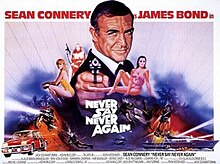 British picture palace poster past Renato Casaro | |
| Directed by | Irvin Kershner |
| Screenplay by | Lorenzo Semple Jr. |
| Story by |
|
| Based on | Thunderball by Ian Fleming |
| Produced past | Jack Schwartzman |
| Starring |
|
| Cinematography | Douglas Slocombe |
| Edited by | Ian Crafford |
| Music past | Michel Legrand |
| Product | Taliafilm |
| Distributed past |
|
| Release dates |
|
| Running time | 134 minutes |
| Countries |
|
| Language | English |
| Budget | $36 million |
| Box part | $160 million[2] |
Never Say Never Again is a 1983 spy movie directed by Irvin Kershner. The flick is based on the 1961 James Bond novel Thunderball past Ian Fleming, which in plow was based on an original story by Kevin McClory, Jack Whittingham, and Fleming. The novel had been previously adapted in a 1965 film of the aforementioned name. Never Say Never Again was not produced by Eon Productions, but by Jack Schwartzman'southward Taliafilm. The film was executive produced by Kevin McClory, one of the original writers of the Thunderball storyline. McClory retained the filming rights of the novel following a long legal battle dating from the 1960s.
Sean Connery played the role of Bond for the seventh and final fourth dimension, marking his return to the character 12 years afterward Diamonds Are Forever. The film'south title is a reference to Connery's reported declaration in 1971 that he would "never" play that part over again. As Connery was 52 at the time of filming, although nigh three years younger than incumbent Bail Roger Moore, the storyline features an aging Bond who is brought back into activity to investigate the theft of two nuclear weapons by SPECTRE. Filming locations included France, Espana, the Bahamas and Elstree Studios in the U.k..
Never Say Never Again was released by Warner Bros. on 7 Oct 1983, and opened to positive reviews, with the acting of Connery and Klaus Maria Brandauer singled out for praise as more emotionally resonant than the typical Bail films of the day. The film was a commercial success, grossing $160 million at the box office, although less overall than the Eon-produced Octopussy, released earlier the same year.
Plot [edit]
After MI6 agent James Bail, 007, fails a routine training exercise, his superior, K, orders Bond to a health dispensary outside London to go back into shape. While at that place, Bond witnesses a mysterious nurse named Fatima Chroma giving a sadomasochistic chirapsia to a patient in a nearby room. The human being'due south face up is bandaged and subsequently Chroma finishes her beating, Bond sees the patient using a machine which scans his middle. Bond is seen by Blush, who sends an assassin, Lippe, to kill him in the clinic gym, only Bail manages to impale Lippe.
Blush and her charge, a heroin-addicted The states Air Force airplane pilot named Jack Petachi, are operatives of SPECTRE, a criminal system run by Ernst Stavro Blofeld. Petachi has undergone an operation on his right eye to make it match the retinal pattern of the US President, which he uses to circumvent iris recognition security at RAF Station Swadley, an American armed services base in England. While doing so, he replaces the dummy warheads of two AGM-86B cruise missiles with live nuclear warheads; SPECTRE then steals the warheads, intending to extort billions of dollars from NATO governments. Blush murders Petachi by causing his automobile to crash and explode, covering SPECTRE'due south tracks.
Strange Secretary Lord Ambrose orders a reluctant M to reactivate the double-0 department, and Bail is tasked with tracking downward the missing weapons. Bond follows a lead to the Bahamas where he meets Domino Petachi, the pilot'south sis, and her wealthy lover Maximillian Largo, who is SPECTRE's top amanuensis.
Bond is informed by Nigel Minor-Fawcett of the British High Commission that Largo'southward yacht is at present heading for Nice, France. There, Bond joins forces with his French contact Nicole, and his CIA analogue and friend, Felix Leiter. Bail goes to a wellness and beauty centre where he poses as an employee and, while giving Domino a massage, is informed by her that Largo is hosting an issue at a casino that evening. At the charity event, Largo and Bond play a three-D video game called Domination; the losing player of each turn receives a series of electric shocks of increasing intensity in proportion to the amount wagered. After losing a few games, Bond ultimately wins, and while dancing with Domino, he informs her that her brother had been killed on Largo's orders. Bond returns to his villa to find Nicole killed past Chroma. After a vehicle chase on his Q-branch motorbike, Bond finds himself in an deadfall and is somewhen captured by Blush. She admits that she is impressed with him, and forces Bond to declare in writing that she is his "Number Ane" sexual partner. Bail distracts her with promises, and so uses his Q-branch-issue fountain pen gun to kill Chroma with an explosive dart.
Bond and Leiter attempt to board Largo's motor yacht, the Flight Saucer, in search of the missing nuclear warheads. Bond finds Domino. He attempts to make Largo jealous by kissing Domino in front end of a two-way mirror. Largo becomes enraged, traps Bond and takes him and Domino to Palmyra, Largo's base of operations in North Africa. Largo coldly punishes Domino for her expose by selling her to some passing Arabs. Bond subsequently escapes from his prison and rescues her.
Domino and Bond reunite with Leiter on a U.S. Navy submarine. Subsequently the start warhead is found and defused in Washington, D.C., they runway Largo to a location known every bit the Tears of Allah, below a desert oasis on the Ethiopian coast. Bond and Leiter infiltrate the underground facility and a gun battle erupts betwixt Leiter'due south squad and Largo'southward men in the temple. In the confusion, Largo makes a getaway with the second warhead. Bond catches and fights Largo underwater. But every bit Largo tries to use a spear gun to shoot Bond, he is shot with a spear gun by Domino, taking revenge for her blood brother's decease. Bond then defuses the nuclear flop underwater, saving the earth. Bond retires from duty and returns to the Bahama islands with Domino, vowing never again to be a secret amanuensis.
Bandage [edit]
- Sean Connery as James Bond, MI6 amanuensis 007.
- Klaus Maria Brandauer as Maximillian Largo, a billionaire man of affairs and SPECTRE Number i, SPECTRE'south senior-nearly amanuensis. He is based on the character Emilio Largo in Thunderball
- Max von Sydow as Ernst Stavro Blofeld, the head of SPECTRE.
- Barbara Carrera as Fatima Blush; SPECTRE Number 12, assigned to chase down and impale Bond. She is based on Fiona Volpe in Thunderball.
- Kim Basinger as Domino Petachi, sister of Jack Petachi and girlfriend/mistress of Maximillian Largo. The surname was changed to Petrescu for the Italian release of the film.
- Bernie Casey as Felix Leiter, Bond'southward CIA contact and friend.
- Alec McCowen equally "Q" Algy (Algernon), Double-0 section Quartermaster who issues specialised equipment to Bond.
- Edward Fox as "Chiliad", Bond's superior at MI6.
- Pamela Salem every bit Miss Moneypenny, M'southward secretary.
- Rowan Atkinson as Nigel Small-Fawcett, Strange Office representative in the Bahamas.
- Valerie Leon every bit Lady in Bahamas, whom Bond seduces.
- Milow Kirek every bit Dr. Kovacs, a nuclear physicist working for SPECTRE.
- Pat Roach as Lippe, a SPECTRE assassinator who tries to kill Bond at the clinic.
- Anthony Sharp as Lord Ambrose, Strange Secretary who orders M to reactivate the Double-0 section.
- Prunella Gee as Nurse Patricia Fearing, a physiotherapist at the clinic.
- Gavan O'Herlihy as Helm Jack Petachi, a USAF airplane pilot used by SPECTRE to steal the nuclear missiles, and Domino Petachi's brother.
Product [edit]
Never Say Never Again had its origins in the early 1960s, post-obit the controversy over the 1961 Thunderball novel.[3] Fleming had worked with independent producer Kevin McClory and scriptwriter Jack Whittingham on a script for a potential Bail pic, to exist called Longitude 78 W,[4] which was subsequently abandoned considering of the costs involved.[5] Fleming, "e'er reluctant to let a good idea lie idle",[5] turned this into the novel Thunderball, for which he did not credit either McClory or Whittingham;[6] McClory then took Fleming to the High Court in London for alienation of copyright[vii] and the matter was settled in 1963.[4] After Eon Productions started producing the Bond films, it later on made a deal with McClory, who would produce Thunderball, and then not make any further version of the novel for a menstruum of ten years following the release of the Eon-produced version in 1965.[viii]
In the mid-1970s McClory again started working on a projection to bring a Thunderball adaptation to product and, with the working title Warhead, he brought writer Len Deighton together with Sean Connery to work on a script.[9] A lawsuit with Eon Productions ended in a ruling that McClory owned the sole rights to SPECTRE and Blofeld, forcing Eon to remove them from The Spy Who Loved Me (1977).[ten] The script initially focused on SPECTRE shooting down airplanes over the Bermuda Triangle before taking over Liberty Island and Ellis Isle as staging areas for an invasion of New York City through the sewers nether Wall Street. The script was purchased by Paramount Pictures in 1978.[x] The script ran into difficulties later accusations from Danjaq and United Artists that the projection had gone beyond copyright restrictions, which bars McClory to a film based only on the novel Thunderball, and once once again the project was deferred.[8]
Towards the end of the 1970s developments were reported on the projection under the proper noun James Bond of the Secret Service,[8] but when producer Jack Schwartzman became involved in 1980 and cleared a number of the legal issues that nevertheless surrounded the project[x] [iii] he decided against using Deighton's script. The project returned to the original nuclear terrorism plot of the original Thunderball in order to avoid another lawsuit from Danjaq and afterward McClory saw Jimmy Carter mention the result in a 1980 presidential fence with Ronald Reagan.[11] Schwartzman brought on board scriptwriter Lorenzo Semple, Jr.[12] to work on the screenplay, who Schwartzman wanted to make the screenplay "somewhere in the centre" betwixt his campier projects such equally Batman and his more serious projects such every bit 3 Days of the Condor.[10] Connery was unhappy with some aspects of the work and asked Tom Mankiewicz, who had rewritten Diamonds Are Forever, to work on the script; notwithstanding, Mankiewicz declined equally he felt he was under a moral obligation to Eon's Albert R. Broccoli.[thirteen] Semple Jr. ultimately left the projection afterwards Irvin Kershner was hired as managing director and Schwartzman began cutting out the "large numbers" from his script to save on the upkeep.[10] Connery then hired British television writers Dick Clement and Ian La Frenais[eleven] to undertake re-writes, although they went uncredited for their efforts despite much of the final shooting script being theirs. This was considering of a restriction past the Writers Social club of America.[14] Cloudless and La Frenais continued rewriting during the product, often altering information technology from twenty-four hours to 24-hour interval.[10]
The moving picture underwent one final change in title: after Connery had finished filming Diamonds Are Forever he had pledged that he would "never" play Bail again.[9] Connery'southward wife, Micheline, suggested the championship Never Say Never Again, referring to her husband'south vow[15] and the producers best-selling her contribution past listing on the terminate credits "Championship Never Say Never Again past Micheline Connery". A final try by Fleming'due south trustees to block the film was made in the High Court in London in the spring of 1983, but this was thrown out by the court and Never Say Never Again was permitted to proceed.[sixteen]
Cast and coiffure [edit]
When producer Kevin McClory had get-go planned the picture in 1964, he held initial talks with Richard Burton for the part of Bail,[17] although the project came to nothing because of the legal issues involved. When the Warhead project was launched in the late 1970s, a number of actors were mentioned in the merchandise press, including Orson Welles for the part of Blofeld, Trevor Howard to play M and Richard Attenborough every bit director.[nine]
In 1978, the working championship James Bond of the Underground Service was beingness used and Connery was in the frame once once again, potentially going caput-to-head with the next Eon Bond film, Moonraker.[18] By 1980, with legal issues again causing the project to founder,[nineteen] Connery idea himself unlikely to play the role, as he stated in an interview in the Sunday Express: "When I get-go worked on the script with Len I had no thought of actually being in the moving-picture show."[20] When producer Jack Schwartzman became involved, he asked Connery to play Bond; Connery agreed, negotiating a fee of $3 million ($8 million in 2022 dollars[21]), casting and script blessing, and a percent of the profits.[22] Subsequent to Connery reprising the function, Semple altered the script to include several references to Bond'southward advancing years – playing on Connery existence 52 at the time of filming[22] – and academic Jeremy Black has pointed out that in that location are other aspects of age and disillusionment in the film, such as the Shrubland's porter referring to Bond's car ("They don't make them like that anymore"), the new M having no use for the 00 department and Q with his reduced budgets.[23] Originally Semple wanted to emphasize Bail'south age even farther, writing the script to include him in semi-retirement working aboard a Scottish fishing trawler hunting Soviet Navy submarines in the North Sea.[10] Connery's casting was formally appear in March 1983. He trained with Steven Seagal to help go in shape for the production.[10]
For the primary villain in the film, Maximillian Largo, Connery suggested Klaus Maria Brandauer, the lead of the 1981 Academy Laurels-winning Hungarian film Mephisto.[24] Through the same route came Max von Sydow equally Ernst Stavro Blofeld,[25] although he still retained his Eon-originated white cat in the flick.[26] For the femme fatale, director Irvin Kershner selected former model and Playboy comprehend girl Barbara Carrera to play Fatima Blush – the name coming from one of the early scripts of Thunderball.[14] Carrera said she modeled her operation on the Hindu goddess Kali, and to "mix that in with a piddling bit of black widow and a trivial bit of praying mantis."[10] Carrera's operation as Fatima Blush earned her a Gold Globe Award nomination for Best Supporting Actress,[27] which she lost to Cher for her role in Silkwood.[28] Micheline Connery, Sean's wife, had met up-and-coming extra Kim Basinger at the Grosvenor Firm Hotel in London and suggested her to Connery, and he agreed after Dalila Di Lazzaro refused the Domino function. For the office of Felix Leiter, Connery spoke with Bernie Casey, saying that as the Leiter role was never remembered by audiences, using a black Leiter might make him more memorable.[24] Others cast included comedian Rowan Atkinson, who would afterwards parody Bond in his role of Johnny English language in 2003.[29] Atkinson's character was added by Clement and La Frenais afterward the product had already started in gild to provide the motion picture with a comic relief.[10] Edward Flim-flam was cast as K in gild to portray the character as a young technocrat in dissimilarity to the older portrayal by Bernard Lee, and to parody the Thatcher ministry's budget cuts to regime services.[10]
Connery wanted to convince Richard Donner to direct the film, merely after meeting Donner decided he disliked the script.[ten] Quondam Eon Productions' editor and director of On Her Majesty's Secret Service, Peter R. Hunt, was approached to direct the film but declined due to his previous work with Eon.[30] Irvin Kershner, who had previously worked with Connery on A Fine Madness (1966), and had achieved success in 1980 with The Empire Strikes Back was so hired. A number of the crew from the 1981 film Raiders of the Lost Ark were also appointed, including first assistant director David Tomblin, director of photography Douglas Slocombe, second unit managing director Mickey Moore and production designers Philip Harrison and Stephen Grimes.[24] [31]
Filming [edit]

The Kingdom 5KR which acted equally Largo's ship, the Flying Saucer
Filming for Never Say Never Over again began on 27 September 1982 on the French Riviera for two months[14] before moving to Nassau, the Bahamas in mid-November[12] where filming took identify at Clifton Pier, which was besides one of the locations used in Thunderball.[32] Largo's Palmyran fortress was actually historic Fort Carré in Antibes.[33] Largo'south ship, the Flying Saucer, was portrayed by the yacht Kingdom 5KR, and then owned by Saudi billionaire Adnan Khashoggi and called the Nabila.[34] The underwater scenes were filmed by Ricou Browning, who had coordinated the underwater scenes in the original Thunderball.[ten] Principal photography finished at Elstree Studios where interior shots were filmed.[32] Elstree likewise housed the Tears of Allah underwater cave, which took 3 months to construct, while the Shrublands health spa was filmed at Luton Hoo.[32] [ten] About of the filming was completed in the spring of 1983, although there was some additional shooting during the summertime of 1983.[12]
Production on the film was troubled,[35] with Connery taking on many of the production duties with assistant director David Tomblin.[32] Director Irvin Kershner was critical of producer Jack Schwartzman, saying that, while he was a skilful man of affairs, "he didn't have the experience of a picture producer".[32] After the production ran out of coin, Schwartzman had to fund further production out of his own pocket and after admitted he had underestimated the amount the film would cost to make.[35] There was tension on set between Schwartzman and Connery, who at times barely spoke to each other. Connery was unimpressed with the perceived lack of professionalism behind the scenes and was on record as saying that the whole production was a "bloody Mickey Mouse functioning!"[36]
Steven Seagal, who was a martial arts teacher for this film, broke Connery'southward wrist while grooming. On an episode of The This evening Bear witness with Jay Leno, Connery revealed he did not know his wrist was cleaved until over a decade later.[37]
Music [edit]
James Horner was both Kershner'due south and Schwartzman's starting time choice to etch the score after beingness impressed with his work on Star Trek Two: The Wrath of Khan. Horner, who worked in London for most of the time, wound upwardly unavailable according to Kershner, though Schwartzman afterward claimed Sean Connery vetoed the American. Frequent Bond composer John Barry was invited, only declined out of loyalty to Eon.[38] The music for Never Say Never Over again was written by Michel Legrand, who composed a score like to his work as a jazz pianist.[39] The score has been criticised every bit "anachronistic and misjudged",[32] "bizarrely intermittent"[31] and "the most disappointing feature of the film".[24] Legrand too wrote the primary theme "Never Say Never Again", which featured lyrics by Alan and Marilyn Bergman — who had besides worked with Legrand on the University Accolade-winning song "The Windmills of Your Listen"[40] — and was performed by Lani Hall[24] after Bonnie Tyler, who disliked the song, had reluctantly declined.[41]
Phyllis Hyman besides recorded a potential theme song, written past Stephen Forsyth and Jim Ryan, but the song — an unsolicited submission — was passed over, given Legrand's contractual obligations with the music.[42]
Legal substitutions [edit]

Many of the elements of the Eon-produced Bond films were not present in Never Say Never Over again for legal reasons. These included the gun butt sequence, where a screen total of 007 symbols appeared instead, and similarly there was no "James Bail Theme" to use, although no effort was made to supply another tune.[12] A pre-credits sequence was filmed just not used;[43] instead the movie opens with the credits run over the top of the opening sequence of Bond on a training mission.[32]
Release and reception [edit]
Never Say Never Again opened on 7 October 1983 in 1,550 theatres grossing an October record $10,958,157 over the four-day Columbus Twenty-four hour period weekend[2] which was reported to exist "the best opening tape of whatsoever James Bail film" up to that point[44] surpassing Octopussy 'due south $8.9 million from June that year. The moving picture had its United kingdom of great britain and northern ireland premiere at the Warner West Finish movie house in Leicester Square on 14 Dec 1983.[32] Worldwide, Never Say Never Again grossed $160 1000000,[45] which was a solid render on the budget of $36 million.[45] The pic ultimately earned less than Octopussy which grossed $187.5 million.[46] [47] It was the outset James Bond film to be officially released in the Soviet Union, premiering in the summertime of 1990 with a gala in Moscow.[48]
Warner Bros. released Never Say Never Once again on VHS and Betamax in 1984,[49] and on laserdisc in 1995.[l] After Metro-Goldwyn-Mayer purchased the distribution rights in 1997 (see Legacy, beneath), the company has released the moving-picture show on both VHS and DVD in 2001,[51] and on Blu-ray in 2009.[52]
Gimmicky reviews [edit]
Never Say Never Once more was broadly welcomed and praised past the critics: Ian Christie, writing in the Daily Express, said that Never Say Never Once more was "one of the better Bonds",[53] finding the movie "superbly witty and entertaining, ... the dialogue is crisp and the fight scenes imaginative".[53] Christie as well idea that "Connery has lost none of his amuse and, if anything, is more appealing than ever every bit the stylish resolute hero".[53] David Robinson, writing in The Times as well concentrated on Connery, saying that: "Connery ... is dorsum, looking hardly a 24-hour interval older or thicker, and still outclassing every other exponent of the part, in the goodnatured throwaway with which he parries all the sexual practice and violence on the way".[54] For Robinson, the presence of Connery and Klaus Maria Brandauer equally Maximillian Largo "very nearly make it all worthwhile."[54] The reviewer for Time Out summed up Never Say Never Once again saying "The activity's good, the photography splendid, the sets decent; but the real clincher is the fact that Bail is once more played by a man with the right stuff."[55]
Derek Malcolm in The Guardian showed himself to be a fan of Connery's Bond, saying the film contains "the best Bond in the business organization",[56] but nevertheless did not detect Never Say Never Once more whatever more enjoyable than the recently released Octopussy (starring Roger Moore), or "that either of them came very most to matching Dr. No or From Russian federation with Dearest".[56] Malcolm's main issue with the picture show was that he had a "feeling that a constant struggle was going on between a desire to make a huge box-office success and the endeavor to brand character as important every bit stunts".[56] Malcolm summed upwards that "the mix remains obstinately the same – up to scratch but not surpassing it".[56] Writing in The Observer, Philip French noted that "this curiously muted film ends up making no contribution of its own and inviting damaging comparisons with the original, hyper-confident Thunderball".[57] French ended that "like an hour-glass total of damp sand, the flick moves with increasing slowness as information technology approaches a dislocated climax in the Persian Gulf".[57]
Writing for Newsweek, critic Jack Kroll thought the early office of the moving-picture show was handled "with wit and style",[58] although he went on to say that the manager was "hamstrung by Lorenzo Semple'south script".[58] Richard Schickel, writing in Fourth dimension magazine praised the film and its cast. He wrote that Klaus Maria Brandauer's grapheme was "played with silky, neurotic charm",[59] while Barbara Carrera, playing Fatima Blush, "deftly parodies all the fatal femmes who have slithered through Bail's career".[59] Schickel's highest praise was saved for the return of Connery, observing "it is good to see Connery'due south grave stylishness in this role again. It makes Bond's cynicism and opportunism seem the product of 18-carat worldliness (and world weariness) as opposed to Roger Moore'south mere twirpishness."[59]
Janet Maslin, writing in The New York Times, was broadly praising of the motion-picture show, saying she thought that Never Say Never Again "has noticeably more humor and character than the Bond films unremarkably provide. Information technology has a marvelous villain in Largo."[60] Maslin too idea highly of Connery in the role, observing that "in Never Say Never Again, the formula is broadened to arrange an older, seasoned man of much greater stature, and Mr. Connery expertly fills the beak."[60] Writing in The Washington Post, Gary Arnold was fulsome in his praise, saying that Never Say Never Once again is "one of the best James Bail gamble thrillers always fabricated",[61] going on to say that "this motion picture is probable to remain a cherished, savory example of commercial filmmaking at its most acute and achieved."[61] Arnold went further, proverb that "Never Say Never Again is the best acted Bond motion-picture show ever made, because information technology clearly surpasses whatever predecessors in the area of inventive and clever graphic symbol delineation".[61]
The critic for The Globe and Post, Jay Scott, also praised the film, maxim that Never Say Never Again "may exist the but instalment of the long-running series that has been helmed by a offset-rate director."[62] According to Scott, the manager, with high-quality support cast, resulted in the "classiest of all the Bonds".[62] Roger Ebert gave the film 3½ out of 4 stars, and wrote that Never Say Never Over again, while consisting of a bones "Bond plot", was different from other Bail films: "For i affair, in that location's more than of a human chemical element in the picture show, and it comes from Klaus Maria Brandauer, equally Largo."[63] Ebert went on to add together, "there was never a Beatles reunion ... simply here, by God, is Sean Connery as Sir James Bail. Adept work, 007."[63] Gene Siskel of The Chicago Tribune as well gave the film 3½ out of four stars, writing that the motion-picture show was "one of the all-time 007 adventures e'er made".[64]
Colin Greenland reviewed Never Say Never Again for Imagine magazine, and stated that "Never Say Never Again is a complacent male sexist fantasy, where women can be just femmes fatales or passive victims."[65]
Retrospective reviews [edit]
Because Never Say Never Once more is not an Eon-produced moving picture, it has non been included in a number of subsequent reviews. Norman Wilner of MSN said that 1967'south Casino Royale and Never Say Never Over again "exist exterior the 'official' continuity, [and] are excluded from this list, simply as they're absent-minded from MGM'south megabox. But have my word for information technology; they're both pretty awful".[66] Retrospective reviews of the picture show remain positive. Rotten Tomatoes sampled 53 critics and judged 70% of the reviews equally positive, with an boilerplate rating of 5.60/x. The site'southward critical consensus reads: "While the rehashed story feels rather uninspired and unnecessary, the return of both Sean Connery and a more than understated Bond make Never Say Never Again a watchable retread."[67] The score is all the same more positive than some of the Eon films, with Rotten Tomatoes ranking Never Say Never Again 16th among all Bond films in 2008.[68] On Metacritic, the motion-picture show has a weighted average score of 68 out of 100 based on 15 critics, indicating by and large favourable reviews.[69] Empire gives the picture show three of a possible five stars, observing that "Connery was perhaps wise to telephone call it quits the first time round".[70] IGN gave Never Say Never Again a score of 5 out of 10, claiming that the film "is more miss than hitting".[71] The review also idea that the film was "marred with too many clunky exposition scenes and non enough moments of Bail being Bond".[71]
In 1995 Michael Sauter of Entertainment Weekly rated Never Say Never Again equally the ninth best Bond film to that point, after 17 films had been released. Sauter thought the film "is successful only as a portrait of an over-the-hill superhero." He admitted that "even by his prime, Connery proves that nobody does information technology better".[72] James Berardinelli, in his review of Never Say Never Again, thinks the re-writing of the Thunderball story has led to a motion picture which has "a hokey, jokey experience, [information technology] is maybe the worst-written Bail script of all".[73] Berardinelli concludes that "information technology'due south a major disappointment that, having lured back the original 007, the film makers couldn't offering him something ameliorate than this fatigued-out, hackneyed story."[73] Critic Danny Peary wrote that "it was great to run into Sean Connery return as James Bail after a dozen years".[74] He also thought the supporting cast was good, saying that Klaus Maria Brandauer's Largo was "neurotic, vulnerable ... one of the most complex of Bond's foes"[74] and that Barbara Carrera and Kim Basinger "make lasting impressions."[74] Peary also wrote that the "film is exotic, well acted, and stylishly directed ... It would exist ane of the best Bond films if the finale weren't disappointing. When will filmmakers realize that underwater fight scenes don't work considering viewers ordinarily tin't tell the hero and villain apart and they know doubles are being used?"[74]
Legacy [edit]
Originally Never Say Never Once again was intended to starting time a serial of Bond films produced by Schwartzman and starring Connery as James Bond, with McClory announcing the next planned motion-picture show S.P.East.C.T.R.E in a February 1984 issue of Screen International.[75] When Connery announced that he would not reprise his part every bit Bail in another moving-picture show produced by Schwartzman three weeks before the deadline to purchase the rights to another film for $5 million, Schwartzman said that he was unlikely to make another picture show without a deal from MGM/UA and Danjaq.[48] [76]
In the 1990s, McClory announced plans to make some other accommodation of the Thunderball story starring Timothy Dalton entitled Warhead 2000 Advertising, simply the pic was eventually scrapped.[77] In 1997 Sony Pictures caused McClory's rights for an undisclosed amount,[iv] and subsequently appear that information technology intended to brand a serial of Bond films, equally the company besides held the rights to Casino Royale.[78] This move prompted a round of litigation from MGM, which was settled out-of-court, forcing Sony to give up all claims on Bond; McClory still claimed he would proceed with another Bail movie,[79] and connected his example against MGM and Danjaq;[eighty] On 27 Baronial 2001 the courtroom rejected McClory'southward accommodate.[81] McClory died in 2006;[77] MGM's acquisition of the rights to Casino Royale finally allowed Eon Productions to make a serious, non-satirical moving picture accommodation of that novel the same yr with Daniel Craig as James Bond. Ultimately, McClory'south heirs sold the Thunderball rights to Eon, allowing the company to reintroduce Blofeld to the Eon serial in the film Spectre.
On four December 1997, MGM appear that the company had purchased the rights to Never Say Never Once more from Schwartzman'southward company Taliafilm.[82] [83] The visitor has since handled the release of both the DVD and Blu-ray editions of the film.[84] [52]
See besides [edit]
- Outline of James Bond
References [edit]
- ^ "Never Say Never Once again (1983)". BBFC . Retrieved xiii June 2021.
- ^ a b "Never Say Never Again". Box Office Mojo . Retrieved 20 September 2019.
- ^ a b Pfeiffer & Worrall 1998, p. 213.
- ^ a b c Poliakoff, Keith (2000). "License to Copyright – The Ongoing Dispute Over the Buying of James Bond" (PDF). Cardozo Arts & Entertainment Police force Journal. Benjamin N. Cardozo School of Law. 18: 387–436. Archived from the original (PDF) on 31 March 2012. Retrieved 3 September 2011.
- ^ a b Chancellor 2005, p. 226.
- ^ Macintyre 2008, p. 198.
- ^ Macintyre 2008, p. 199.
- ^ a b c Chapman 2009, p. 184.
- ^ a b c Barnes & Hearn 2001, p. 152.
- ^ a b c d e f g h i j k 50 one thousand n Field, Matthew (2015). Some kind of hero : 007 : the remarkable story of the James Bail films. Ajay Chowdhury. Stroud, Gloucestershire. ISBN978-0-7509-6421-0. OCLC 930556527.
- ^ a b "La Frenais, Ian (1936–) and Clement, Dick (1937–)". Screenonline. British Film Found. Retrieved 3 September 2011.
- ^ a b c d Benson 1988, p. 240.
- ^ Mankiewicz & Crane 2012, p. 150.
- ^ a b c Barnes & Hearn 2001, p. 155.
- ^ Dick, Sandra (25 August 2010). "Fourscore big facts yous must know most Big Tam". Edinburgh Evening News. p. twenty.
- ^ Chapman 2009, p. 185.
- ^ "A Rival 007 – It Looks Like Burton". Daily Express. 21 February 1964. p. 13.
- ^ Davis, Victor (29 July 1978). "Bond versus Bail". Daily Limited. p. 4.
- ^ Barnes & Hearn 2001, p. 153.
- ^ Isle of man, Roderick (23 March 1980). "Why Sean won't now be back every bit 007 ...". Sun Express. p. 23.
- ^ 1634–1699: McCusker, J. J. (1997). How Much Is That in Real Money? A Historical Price Index for Use as a Deflator of Money Values in the Economy of the U.s.: Addenda et Corrigenda (PDF). American Antique Society. 1700–1799: McCusker, J. J. (1992). How Much Is That in Real Money? A Historical Price Index for Use as a Deflator of Money Values in the Economy of the Us (PDF). American Antiquarian Society. 1800–nowadays: Federal Reserve Bank of Minneapolis. "Consumer Price Alphabetize (approximate) 1800–". Retrieved 16 April 2022.
- ^ a b Barnes & Hearn 2001, p. 154.
- ^ Black 2004, p. 58.
- ^ a b c d e Benson 1988, p. 243.
- ^ Smith 2002, p. 195.
- ^ Chapman 2009, p. 135.
- ^ "Barbara Carrera". Official Golden World Award Website. Hollywood Strange Printing Association. Retrieved two September 2011.
- ^ "Best Functioning by an Actress in a Supporting Function in a Motion Film". Official Gilded World Award Website. Hollywood Foreign Printing Association. Retrieved iii September 2011.
- ^ "Johnny English" (PDF). Penguin Readers Factsheets. 2003. Archived from the original (PDF) on xxx October 2006. Retrieved five September 2011.
- ^ "Managing director Peter Hunt – "On Her Majesty's Secret Service"". Retrovision. Archived from the original on half-dozen Dec 1998. Retrieved 5 September 2011.
- ^ a b Smith 2002, p. 197.
- ^ a b c d e f g h Barnes & Hearn 2001, p. 156.
- ^ Reeves 2001, p. 134.
- ^ Salmans, Sandra (22 Feb 1985). "Lavish Lifestyle of a Wheeler-Dealer". The New York Times . Retrieved half dozen September 2011.
- ^ a b Smith 2002, p. 199.
- ^ "JAMES Bail 007 Mag | THE BATTLE FOR Bond". 007magazine.co.uk . Retrieved 9 July 2019.
- ^ Kurchak, Sarah (12 October 2015). "Did Steven Seagal Break Sean Connery's Wrist with Aikido?". Vice.com . Retrieved 24 November 2015.
- ^ Jon Burlingame, The Music of James Bail, p. 162, 172, 174. ISBN 978-0-xix-935885-4
- ^ Bettencourt, Scott (1998). "Bond Dorsum in Action Again". Film Score Monthly.
- ^ "The real James Bond is back, and 007's a winner again "Academy Awards Database"". Academy of Motion Picture Arts and Sciences.
- ^ "The Bat Segundo Show: Bonnie Tyler". 12 September 2008. Tyler also discusses this in the documentary James Bond's Greatest Hits.
- ^ Burlingame 2012, p. 112.
- ^ Smith 2002, p. 193.
- ^ Hanauer, Joan (18 October 1983). "Connery Champ". United Press International.
- ^ a b "Never Say Never Once more". Nash Information Services, LLC. Retrieved 1 September 2011.
- ^ "Octopussy". The Numbers. Nash Information Services, LLC. Retrieved 8 August 2011.
- ^ "James Bond Movies at the Box Role". Box Office Mojo . Retrieved 8 Baronial 2011.
- ^ a b "Never Say Never Again". itemize.afi.com . Retrieved 9 June 2021.
- ^ Nielsen Business Media, Inc (21 July 1984). "Billboard Videocassette Top 40". Billboard. p. 35.
- ^ McGowan, Chris (nineteen November 1996). "Home Video: Laser Scans". Billboard. p. 96.
- ^ "Casino Royal and Never Say Never Again". Picture Review (127). April 2001.
- ^ a b "Never Say Never Yet Once again". IGN. 21 Jan 2009. Retrieved 31 August 2011.
- ^ a b c Christie, Ian (18 December 1988). "A Hero's Return". Daily Express. p. 20.
- ^ a b Robinson, David (16 December 1983). "Never Say Never Over again (PG)". The Times. p. 10.
- ^ "Never Say Never Over again (1983)". Time Out . Retrieved 30 Baronial 2011.
- ^ a b c d Malcolm, Derek (fifteen Dec 1983). "True to his Bond". The Guardian. p. 16.
- ^ a b French, Philip (18 December 1983). "Thunderball recycled". The Observer. p. 31.
- ^ a b Kroll, Jack (10 Oct 1983). "Back in the Bond Business". Newsweek. p. 93.
- ^ a b c Schickel, Richard (17 October 1983). "Movie theater: Raking Upwards the Autumn Leavings". Time. Archived from the original on 22 December 2008. Retrieved 31 August 2011.
- ^ a b Maslin, Janet (7 October 1983). "Sean Connery is Seasoned James Bond". The New York Times. p. 13.
- ^ a b c Arnold, Gary (6 October 1983). "'Never': Better Than Ever; Sean Connery Rides Over again in the All-time of Bonds". The Washington Post. p. E1.
- ^ a b Scott, Jay (7 Oct 1983). "A first-rate managing director works wonders: The classiest Bond of all". The Globe and Postal service.
- ^ a b Ebert, Roger (seven Oct 1983). "Never Say Never Once again". rogerebert.com. Retrieved 18 October 2008.
- ^ Siskel, Cistron (07 October 1983). "The existent James Bond is dorsum, and 007'due south a winner again". The Chicago Tribune. p. 63. Retrieved 23 Feb 2022 – via Newspapers.com.

- ^ Greenland, Colin (March 1984). "Moving-picture show Review". Imagine (review). TSR Hobbies (UK), Ltd. (12): 45.
- ^ Norman Wilner. "Rating the Spy Game". MSN. Archived from the original on 19 Jan 2008. Retrieved four March 2008.
- ^ "Never Say Never Again (1983)". Rotten Tomatoes. Fandango. Retrieved 25 September 2021.
- ^ Ryan, Tim (xviii November 2008). "Total Recall: James Bond Countdown – Find Out Where Breakthrough of Solace Fits In!". Rotten Tomatoes. Flixster. Retrieved 5 September 2011.
- ^ "Never Say Never Again Reviews". Metacritic. CBS Interactive. Retrieved 30 June 2018.
- ^ "Never Say Never Once again". Empire. Archived from the original on 24 October 2011. Retrieved 31 August 2011.
- ^ a b Pirrello, Phil (26 March 2009). "Never Say Never Once again Blu-ray Review". IGN. Archived from the original on 8 October 2011. Retrieved 31 August 2011.
- ^ Sauter, Michael (1 July 2008). "Playing The Bond Market". Amusement Weekly. Archived from the original on 29 September 2008. Retrieved 31 August 2011.
- ^ a b Berardinelli, James (1996). "Never Say Never Over again". ReelViews. Retrieved 31 August 2011.
- ^ a b c d Peary 1986, p. 296.
- ^ Aceved, Violet (29 Oct 2015). "James Bond'southward abandoned 'SPECTRE' mission from 1984". Screen . Retrieved ix June 2021.
- ^ London, Michael (18 January 1984). "Film Clips: 'White Dog' Will Have its Day on NBC". Los Angeles Times.
- ^ a b Rye, Graham (7 December 2006). "Kevin McClory". The Independent . Retrieved five September 2011.
- ^ Elliott, Christopher (23 Oct 1997). "Never say never once again when James Bond is involved". The Guardian. p. ten.
- ^ Shprintz, Janet (29 March 1999). "Large Bond-holder". Diversity . Retrieved 10 March 2021.
- ^ Cork, John; Scivally, Bruce (11 November 2002). "Reeling through the years". Variety. p. A15.
- ^ James, One thousand thousand (28 August 2001). "U.S. Court Rejects Claim to James Bail". Los Angeles Times . Retrieved 4 October 2021.
- ^ "Metro-Goldwyn-Mayer Inc. announces conquering of Never Say Never Again James Bail assets" (Press release). Metro-Goldwyn-Mayer. 4 Dec 1997. Archived from the original on 5 May 2008. Retrieved 16 March 2008.
- ^ DiOrio, Carl (4 December 1997). "Mgm, 007 Say 'never' Again". The Hollywood Reporter. Archived from the original on 2 February 2014. Retrieved five September 2011.
- ^ Pratt 2005, p. 851.
Bibliography [edit]
- Barnes, Alan; Hearn, Marcus (2001). Kiss Kiss Bang! Blindside!: the Unofficial James Bail Film Companion. Batsford Books. ISBN978-0-7134-8182-2.
- Benson, Raymond (1988). The James Bond Bedside Companion. London: Boxtree Ltd. ISBNi-85283-234-7.
- Black, Jeremy (2004). Uk Since the Seventies: Politics and Society in the Consumer Historic period. Guilford: Biddles Ltd. ISBN978-1-86189-201-0.
- Black, Jeremy (2005). The Politics of James Bond: from Fleming's Novel to the Big Screen . University of Nebraska Press. ISBN978-0-8032-6240-ix.
- Burlingame, Jon (2012). The Music of James Bail. Oxford: Oxford University Press. ISBN978-0-19-986330-iii.
- Chancellor, Henry (2005). James Bond: The Human and His World. London: John Murray. ISBN978-0-7195-6815-2.
- Chapman, James (2009). Licence to Thrill: A Cultural History of the James Bail Films. New York: I.B. Tauris. ISBN978-one-84511-515-nine.
- Lindner, Christoph (2003). The James Bond Phenomenon: a Critical Reader. Manchester Academy Press. ISBN978-0-7190-6541-5.
- Macintyre, Ben (2008). For Yours Eyes Only. London: Bloomsbury Publishing. ISBN978-0-7475-9527-4.
- Mankiewicz, Tom; Crane, Robert (2012). My Life as a Mankiewicz. Lexington, KY: University Printing of Kentucky. ISBN978-0-8131-3605-9.
- Peary, Danny (1986). Guide for the Film Fanatic. Simon & Schuster. ISBN978-0-671-61081-iv.
- Pfeiffer, Lee; Worrall, Dave (1998). The Essential Bond. London: Boxtree Ltd. ISBN978-0-7522-2477-0.
- Pratt, Douglas (2005). Doug Pratt's DVD: Movies, Television, Music, Fine art, Developed, and More!. London: UNET 2 Corporation. ISBN978-1-932916-01-0.
- Reeves, Tony (2001). The Worldwide Guide to Movie Locations . Chicago: A Cappella. ISBN978-1-55652-432-v.
- Smith, Jim (2002). Bond Films . London: Virgin Books. ISBN978-0-7535-0709-4.
External links [edit]
- Never Say Never Again at IMDb
- Never Say Never Once more at AllMovie
- Never Say Never Once again at Rotten Tomatoes
- Never Say Never Again at Box Office Mojo
- Never Say Never Again at Metro-Goldwyn-Mayer
Source: https://en.wikipedia.org/wiki/Never_Say_Never_Again
0 Response to "Go Outside Never Again Web Comic"
Post a Comment